
From looking to meaning-making.
A configurable public-learning experience for museums, galleries, exhibitions, and immersive media. Curiosity Atlas designs the moment after curiosity begins — when a visitor stops looking and starts thinking, questioning, and connecting.
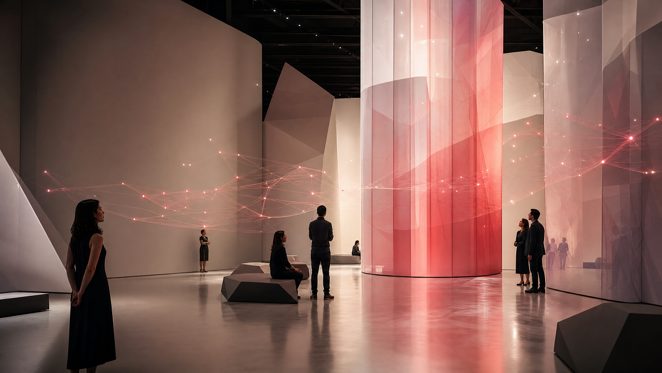
Not another guide app.
Curiosity Atlas is a configurable learning layer, not a fixed product. It sits alongside your exhibition, media programme, or immersive experience — not on top of it. Curatorial and learning ownership stays with you.
For visitors
- A self-directed route through a story, media experience, or curated theme.
- Prompts that reward observation before explanation.
- An optional reflection they can revise, save, or leave behind.
- No requirement to disclose personal identity to participate.
For cultural & learning organisations
- A configurable engagement layer that keeps curatorial and learning ownership with the client.
- A reusable design pattern across physical, digital, video, audio, AR, VR, and hybrid experiences.
- A clearly bounded role for AI — with content sources, review, language, privacy, and accessibility designed in.
- A later, separately governed pathway to de-identified learning insight.
From looking to meaning-making.
Museum objects behind glass. Heritage rooms you walk through but cannot handle. Immersive video that ends and leaves you unsure what to do with it. Curiosity Atlas designs for the visitor moment where seeing turns into thinking — noticing, questioning, and connecting what is in front of you to what is already in you.
Notice
Describe what you notice.
Interpret
Ask questions the object or moment invites.
Connect
Link what you notice to something you already know or feel.
Reflect
Save one thought worth taking away.
A self-directed route, from arrival to reflection.
Six journey components. Every one is configurable to your context. Every one has a text alternative, a skip route, and an owner named in delivery.
One platform. Different cultural and media contexts.
Curiosity Atlas ships as four reference patterns you configure to your visitor moment. Each pattern is a starting point for a Studio-designed experience, not a template you deploy unchanged.
Collection Compass
Art · Design · History · Community · Small museums
Object and collection cards, comparison prompts, short AI-supported inquiry, and a thematic journey map.
Story Worlds
Heritage · Community archives · Identity-led exhibitions
Multiple-perspective story paths across people, place, memory, craft, and belonging.
Immersive Pathways
VR · AR · Spatial · Interactive installations
Before, during, and after prompts that transform an immersive moment into interpretable learning.
Screen Sense
Video-led exhibitions · Screenings · Public learning
Guided-viewing prompts, brief pause points, optional conversation, and a post-viewing reflection.
VR and video can become reflection — not just spectacle.
Immersive experiences work when visitors have time to look, time to feel, and a route into what happens after. Curiosity Atlas frames the before, during, and after of a VR or video moment so the memory does not evaporate at the exit.
Before the immersion
A light, curated prompt sets attention without spoiling the encounter.
During (optional)
A moment to pause, mark, or note — never interrupting flow.
After the immersion
A reflection prompt links what was seen to a question, a comparison, or a personal connection.
A clear role for AI. A clear role for people.
Curiosity Atlas uses AI where it helps a visitor look more closely or organise a thought. It does not use AI to judge, profile, or replace curatorial and educator work.
Content-grounded conversation
The AI uses only client-approved source material and names its limits when a question is outside the approved content.
Visitor agency
Visitors can skip AI conversation, correct or delete anything proposed about them, and continue without personal disclosure.
No hidden learner profiling
We do not infer personality, emotion, cultural identity, political opinion, learning ability, or demographic attributes from visitor input.
Transparent support
AI interaction is clearly labelled. What is stored, transcribed, summarised, or deleted is named in the visitor notice before use.
Human escalation
For sensitive content, a client-approved information or support route is provided. The AI does not attempt to resolve a personal issue.
Data protection and Singapore compliance
Where a Curiosity Atlas experience processes visitor input, transcripts, or personal data, delivery is designed in line with Singapore's Personal Data Protection Act (PDPA). Consent, retention, access, and cross-border handling are agreed with the client during discovery and named in the visitor notice before launch.
Where an AI provider is located outside Singapore, cross-border transfers of personal data are handled in accordance with PDPA §26 — the provider, the region, and the data-handling terms are named in the client's user-facing notice. Anonymisation, where used, follows a deliberate process rather than a simple removal of names.
The Data Protection Officer is contactable at contactadmin@learning-legacy.org.
This is product design guidance, not legal advice. Each client should have its DPO, research-ethics, and legal owners confirm their own compliance decisions.
A clear path from visitor moment to launch.
We start with the visitor moment you want people to remember — not a technology demo. Four phases. Named owners at every gate. A pilot before launch.
I.
Discovery
Name the visitor moment, audience, media context, learning goal, source content, accessibility needs, and AI boundaries. Confirm privacy and Product 03 stance.
II.
Design
Journey (Explore → Focus → Discover → Journey Map → Reflection), reference pattern selection, AI grounding rules, Learning Trace decision.
III.
Pilot
Functional prototype, small visitor pilot, feedback review, improvement priorities.
IV.
Launch & care
Refine, launch, handover to your team for ongoing ownership. Optional ongoing content and moderation support.
Bring us the visitor moment you want people to remember.
Curiosity Atlas begins with a discovery conversation — the visitor moment, the audience, the media context, the source content, and the accessibility and privacy decisions that will shape the experience.
Start an enquiry ↗